- Builds a collaborative framework with Gyeongju City, the Korea Textile Development Institute, and banner manufacturers
- Delivers an initial batch of 200 chemically recycled banners, with Korea Eco-Label certification and institutional improvements underway to help the model take root
SK Chemicals has established a stable collaborative framework with Gyeongju City, the Korea Textile Development Institute (KTDI), Daehan Media, and Re&Saeng to turn waste banners back into banners, and is now beginning the actual supply of chemically recycled banners.
SK Chemicals (CEO Ahn Jae-hyun) announced on [DATE] that it will supply an initial batch of 200 banners made from chemically recycled waste banners to Gyeongju City. The chemically recycled banners will be displayed in high-traffic public spaces, including the city’s designated public banner boards. Each banner will carry a dedicated logo created by Gyeongju City to distinguish it from conventional banners.
According to the company, this supply is significant because it is the result of a collaborative framework that six organizations have built since early this year: SK Chemicals, Gyeongju City, KTDI, Daehan Media, Re&Saeng, and the Korea Radioactive Waste Agency (KORAD). Together, they have established a commercialization system covering the entire process, from collecting waste banners through feedstock conversion, materials production, banner manufacturing, and verification to actual use.
To support this, Gyeongju City opened a new public collection depot in July and established a collection system that gathers waste banners, which had previously been incinerated, at the depot so that the entire volume can be recovered as resources.
The collected waste banners undergo pre-processing, such as shredding and melting, to be converted into a form suitable for chemical recycling. SK Chemicals then uses its depolymerization process to produce recycled feedstock and materials from them.
KTDI is responsible for yarn production, spinning the recycled material into yarn, while Daehan Media and Re&Saeng handle product manufacturing by producing banner fabric from the recycled yarn. KORAD, which is headquartered in Gyeongju, serves as the end user, purchasing and using the finished chemically recycled banners.
Quality has also been verified. According to an evaluation by KTDI, a specialized textile research institute, yarn made from recycled feedstock achieved spinnability and fiber quality on par with yarn made from petroleum-based feedstock.
The process has also delivered tangible resource circulation results. According to Gyeongju City, the city’s waste banner recycling rate has more than doubled since the public collection depot began operating, rising from 10% last year to 24.5% this year.
Gyeongju City plans to expand the scope of collection to include illegal banners in cooperation with the Korea Outdoor Advertising Association. To embed this circular structure in the region, the city will also finalize the related institutional improvements and transition to a permanent operating system starting next year. In addition, Daehan Media and Re&Saeng are pursuing Korea Eco-Label certification for the chemically recycled banner fabric.
Waste banners are a typical form of single-use waste, used briefly for events, elections, and similar purposes before being discarded. According to the Ministry of the Interior and Safety and the Ministry of Climate, Energy and Environment, approximately 5,400 tons of waste banners were generated nationwide in 2024, of which only 33.3% were recycled. Efforts to upcycle waste banners into products such as shopping bags and sacks have continued, but they have been limited to one-time recycling.
Depolymerization, which converts waste back into feedstock, is gaining attention as a promising solution to the waste banner problem. The technology breaks polyester down to the molecular level, returns it to feedstock, and then repolymerizes it. This makes it well suited to recovering resources from low-quality waste that is difficult to process through mechanical recycling, which shreds waste plastics for reuse. Banners are a typical example of such low-quality waste, consisting of polyester fibers combined with coatings and inks. Moreover, because quality does not degrade even after repeated recycling, depolymerization allows waste banners to be circulated back into banners, their original application, again and again.
Ko Jeong-seok, Head of SK Chemicals’ Recycling Division, said, “The problem of waste plastics, including waste banners, is a concern shared by all members of society, from businesses to the government, but it has been difficult to resolve at its root at the level of an individual company or local government. This project represents the first fruits of a joint effort by a diverse group of stakeholders, from companies with materials and yarn technologies to local governments and end users. Going forward, we will make company-wide efforts to expand this collaborative model.”
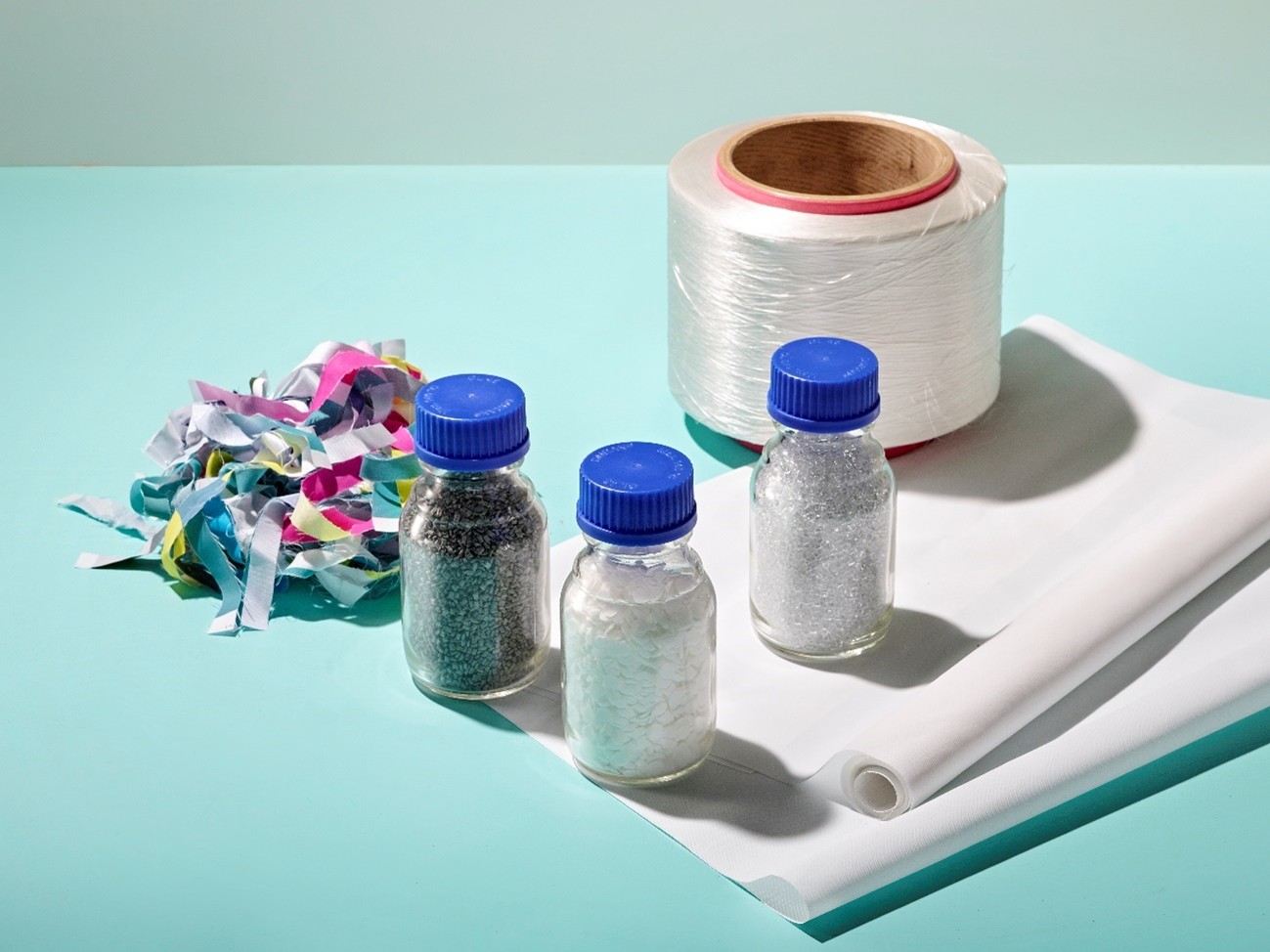
[Photo caption: Products from each stage of the process, in which waste banners are finely shredded, chemically recycled into recycled materials, spun into yarn, and made into banners.]